| Featured Coin |
 |
|
 |
|
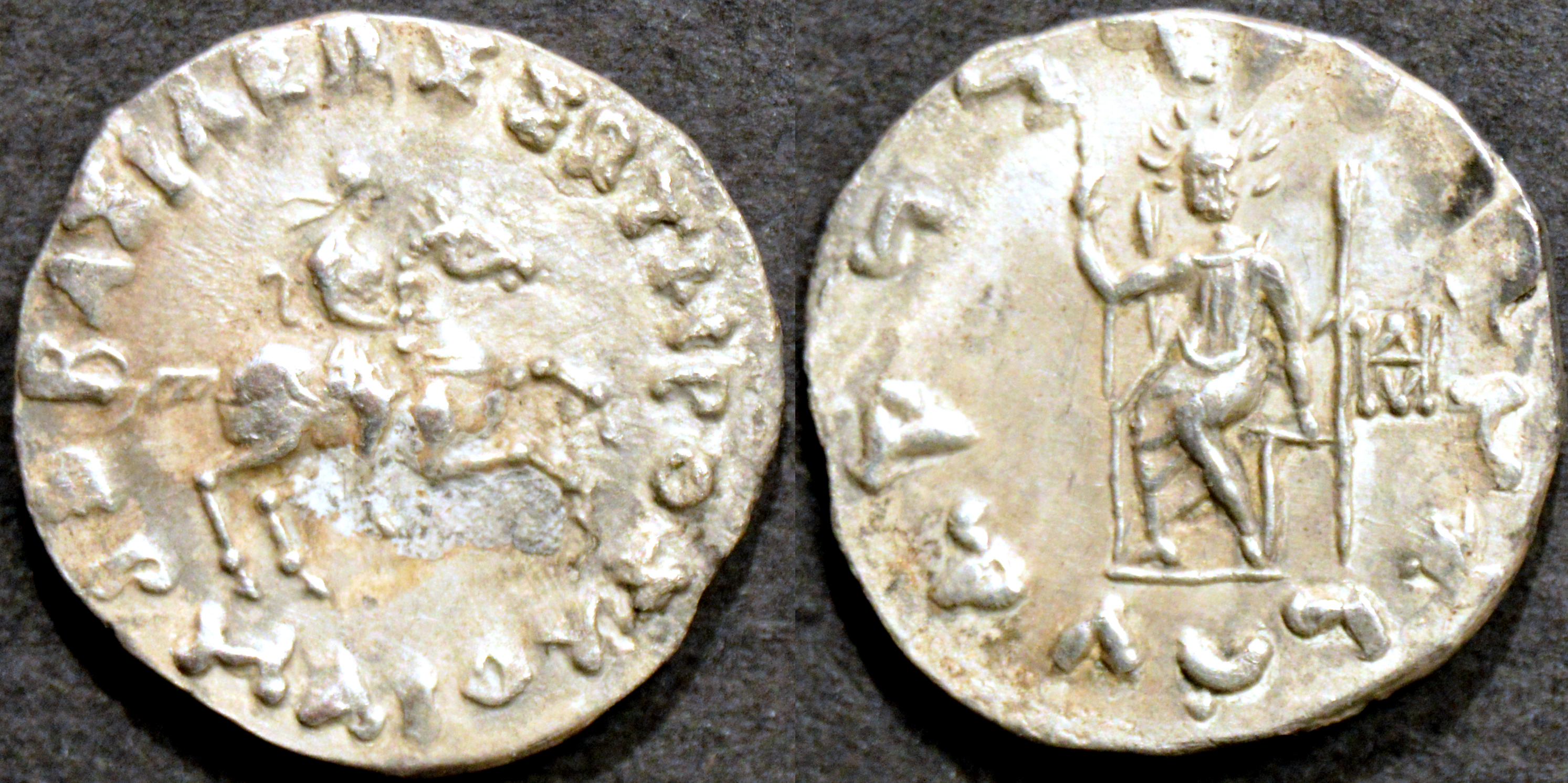
Hermaios, Silver drachm
Weight: 2.38 gm. Diameter: 17 mm Die axis: 12h
Queen (Calliope?) mounted on horse prancing right, Greek legend around:
BAΣIΛEΩΣ ΣΩTHPOΣ EPMAIOY
(Basileos Soteros Hermaiou ... of King Hermaios, the Saviour)
Zeus enthroned three-quarters left, holding sceptre in right hand
and resting left arm on throne arm,
Kharoshthi legend around: maharajasa tratarasa / heramayasa
Reference: MIG ---, Bop 6A
| |
Hermaios (also spelled Hermaues) was the last Greek king to rule in Gandhara and the Kabul valley. His kingdom must have been overrun by
nomadic invaders from the north, the Yueh-Chih. These same nomadic tribes had swept through Bactria in the middle of the second century BCE,
terminating Greek rule in that area, and now, in the early part of the first century BCE, they drove south over the Hindu Kush mountains and
established their rule there also. The vast majority of coins in the name of Hermaios, which are available in large quantities, were
imitations of that king's coins by these invading nomads. The earliest coins of the Kushan king Kujula Kadphises also name Hermaios and
imitate his coins. The lifetime issues of Hermaios are in fact quite scarce, and some types are very rare.
|
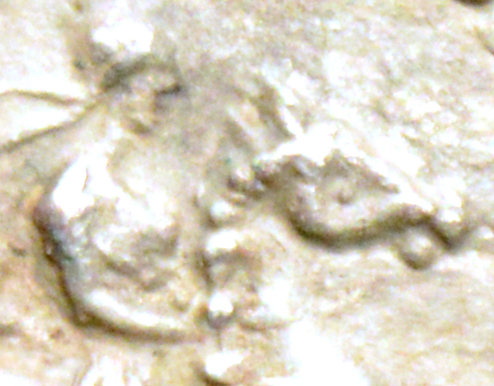 | |
This coin is sometimes described as depicting a king on a prancing horse, but the shape of the
figure's torso (see detail at left) quite clearly indicates a female form. Bopearachchi describes the figure as "Reine Amazone." It seems strange
that Hermaios would place an Amazon queen on his coins. The type recalls the prancing horse type of the Hermaios coins with Calliope, on which the
figure is male, presumably Hermaios himself. Could this figure represent Calliope? Perhaps she had died and Hermaios memorialized her on his coins. |
You can see more coins of Hermaios on the
Hermaios page. You can see the joint coins of Hermaios with Calliope on the
Hermaios and Calliope page.
Previously featured coins can be seen in the Archive of Featured Coins.
A Note on Image Sizes: On the web, it is impossible to present coin images in their actual sizes, the way they can be in print. Throughout the CoinIndia website,
however, an attempt has been made to present the coins in sizes proportional to one another. Thus a coin that has twice the diameter as another coin will be shown as
double in size (with the exception of the image on this page, which is always shown at this fixed size, no matter what the size of the original coin was). Wherever possible, the actual
diameter (for round coins) or dimensions (for rectangular or oddly-shaped coins) is provided. Of course, enlargements of each coin are available by clicking on the images.
|
|